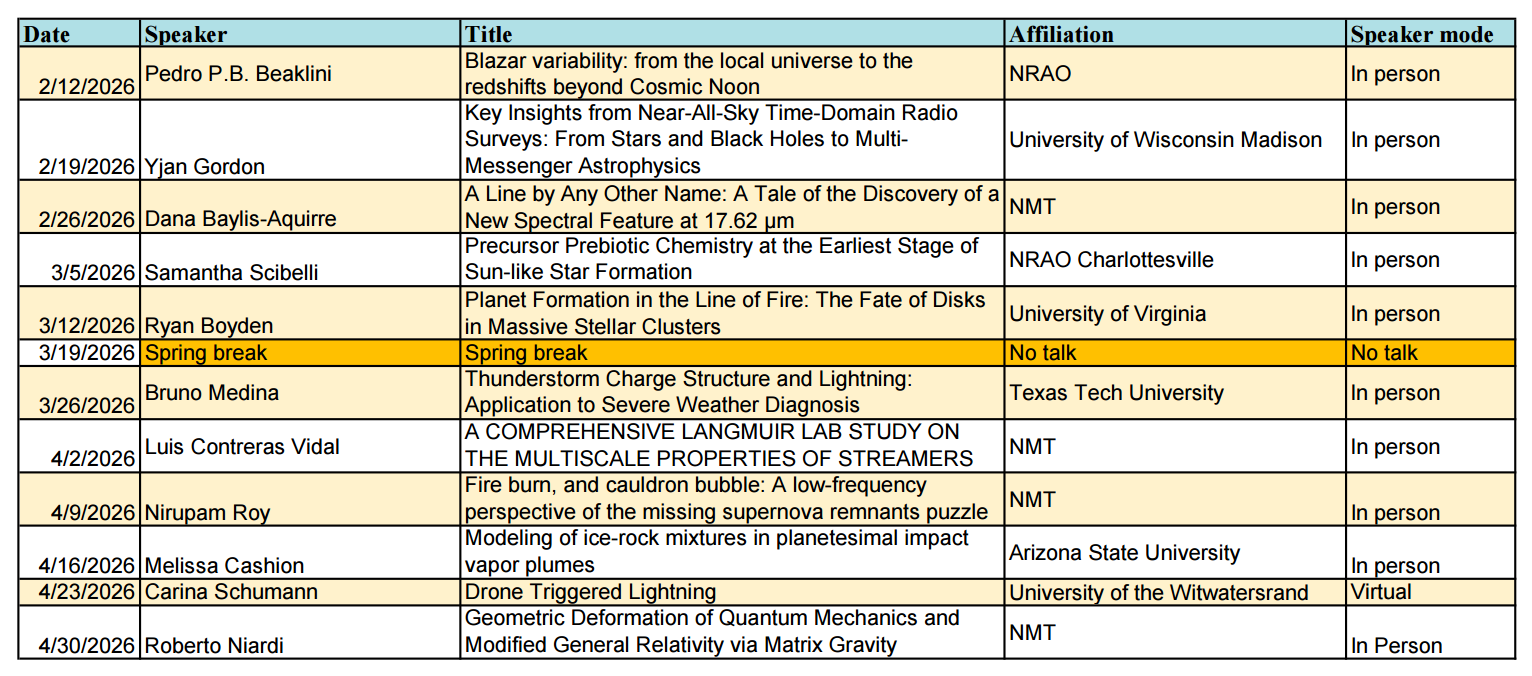
Here is the current schedule for the Spring 2026 semester

Blazar variability: from the local universe to the redshifts beyond Cosmic Noon
Pedro P.B. Beaklini (NRAO)
Blazars are a class of AGNs where the jet is oriented at a small angle with the line of sight. Due to the relativistic Doppler effect, the radiation is boosted, enhancing its apparent brightness and exhibiting variability on different timescales in all wavelengths, ranging from radio to gamma rays. Several blazar sources have been monitored for decades, and the last 20 years have been particularly fruitful, thanks to the high-energy data from the Fermi Gamma-ray Space Telescope. As a result, the correlation between high-frequency and radio emission has become better understood. However, the behaviour of blazars in the early universe still needs to be revealed. The number of quasars detected at high redshift (> 4) is increasing fast, but only a few have been detected in radio. The existence of quasars in the young universe is challenging because the current model does not expect that a supermassive black hole would grow so fast. One main hypothesis to address this issue is that early jets could increase accretion and shorten the growth time, and blazars are the ideal class to study the jets. In this talk, I will present new data obtained with the Very Large Array at 1.5, 3, and 6 GHz of a sample of blazars located beyond the cosmic noon. The observed frequency ranges between 6 and 40 GHz in the source frame, and we are, for the first time, monitoring the variability of these early targets with a weekly cadence.
Zoom Link: (https://nmt-edu.zoom.us/j/97572348560?pwd=OLHjHRLKVCeL1LnUsxGTFMLrDJagQv.1)
Meeting Id: 975 7234 8560; Passcode: 677943